Out August 18, 2026

Structure & Spark
A Flexible Framework to Manage Every Classroom Curveball
The first classroom management guide that changes with your school year, so you stop reacting to behavior problems and start seeing them coming.
Available August 18 · Paperback
You tried everything.
And nothing worked.
You tried the clip chart the teacher next door swears by. Then the schoolwide points system. Then punch tickets, behavior bingo, and on the bad days, flat-out bribes that turned into threats as your patience evaporated.
Everyone said these would work. So when they didn't, you figured it was you.
"But you're not the problem, and your kids aren't the problem either. The real problem is that we've been tasked with building an entire management system on the shifting sand of student engagement."Structure & Spark, Chapter 1 · emphasis added
Engagement moves all day long. It always has. If your whole system rests on it holding still, then the moment it shifts, your system goes with it — and no clip chart or marble jar can change the tide. They can only respond to it.
So the question isn't which system to try next. It's how to read what your room needs on a given Tuesday, and what to do about it before it turns into a bad afternoon.
And it's easier to see those problems coming than you'd think.
One scale. Two buckets.
Everything in the book comes back to this one picture. Structure in one bucket, spark in the other. Too much structure and the room goes bored. Too much spark and it goes over. In the middle is engagement.
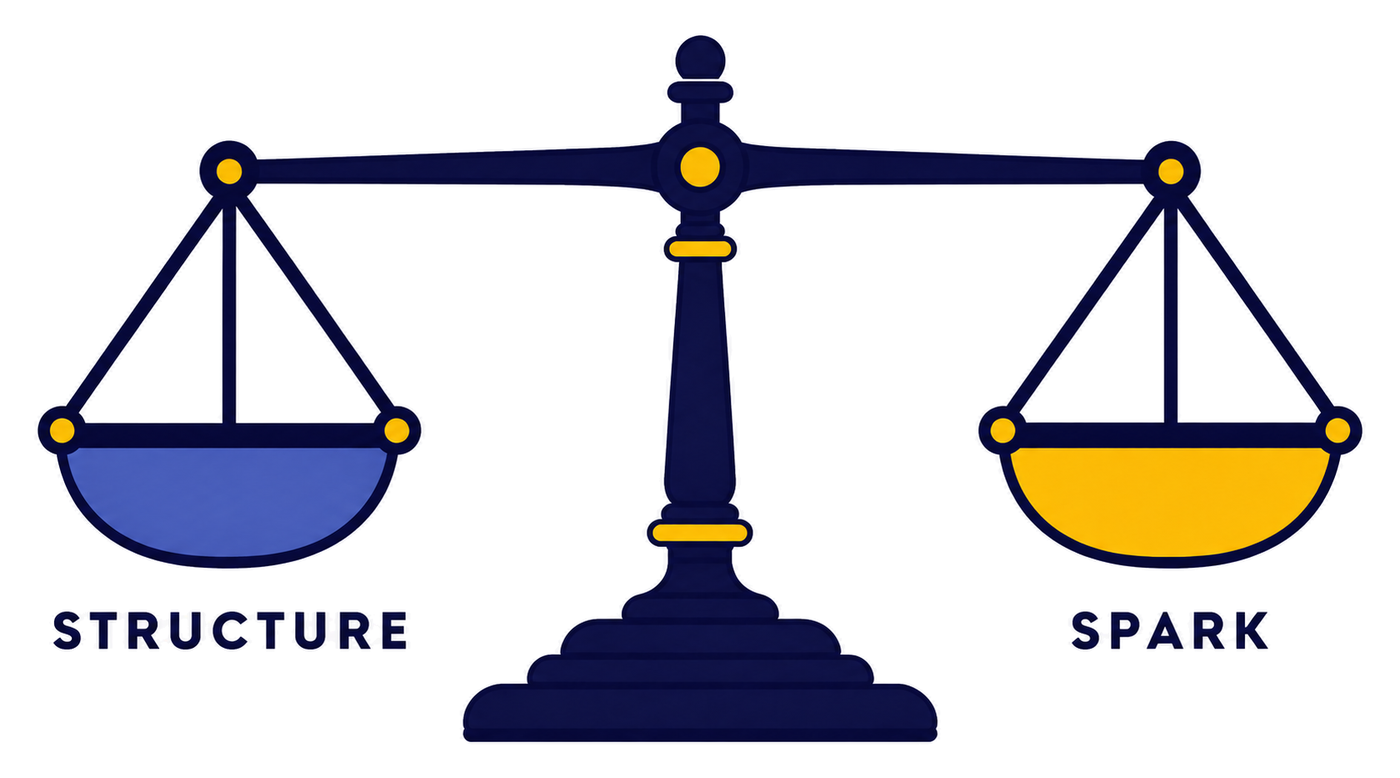
Routines, expectations, systems
Novelty, freshness, the reason to lean in
So when the room tips into chaos, you add structure. When it goes flat and glassy-eyed, you add spark.
"That is why engagement is not separate from classroom management. It is classroom management."Structure & Spark, Chapter 1 · emphasis added
You don't need another system.
- You don't need one more thing to laminate and maintain.
- You don't need something that takes a whole summer to set up.
- You don't need to become a different kind of teacher than the one you are.
What you need is a plan that moves with your year — because the behavior you're managing in September is not the behavior you're managing in May.
When you understand how to balance structure and spark.
Still holding in February
The procedures you taught in September didn't quietly come apart over the winter. They're doing exactly what you built them to do.
It works the first time
Your attention signal lands on the first try — even during inside recess, even in the middle of a ramp-up week.
December, handled in November
You walk into the Holiday Ramp-Up with a game plan already made, instead of finding out what it does to your room the hard way.
You know which tool to reach for
Not guessing, not scrolling for ideas at ten at night. You read what the room needs, and you already know what to do about it.
Seven seasons. Twenty-nine tools.
You already feel these shifts. Nobody has ever handed you a plan built around them. Every chapter closes with a Try It Today step — one small thing, genuinely small, that you can do tomorrow.
Back-to-School: Building a Foundation for Success
Spark is the highest it will be all year, and you're the most tired you'll be at the exact moment you need the most energy. This is where you build the structures that carry you to June.
- Building Classroom Community from Day One
- Teaching Procedures Clearly
- Teaching Expectations that Matter: The Guided Discovery Model
- Creating an Effective Attention Signal
- Running Efficient Transitions
"Every procedure you teach your class adds another coin to the structure side of the scale."
The Season of Settling In: Launching Systems for Success
The honeymoon ends. They're comfortable now, which means they're testing boundaries and starting to get bored. They followed your systems because they were new. Now they need a reason to want to.
- Building Your First Strategic Seating Chart
- Holding Firm on Standards
- Activating Every Student
- Introducing Surprise and Delight
- Teaching Recess Skills to Support Social Success
"Strategic seating is your first defense against boundary-testing."
The Holiday Ramp-Up: Managing the Magic and Mayhem
Swiss cheese weeks. Assemblies, parades, early dismissals. December's joy isn't the problem — it's the imbalance it creates, and your job is steadying the other side of the scale.
- Keeping Expectations Alive
- Maintaining Routines in the Face of Constant Interruptions
- Leaning Into Seasonal Fun Strategically
- Using a Short-Term Rewards System
"The trick isn't to fight the chaos but to shape it, harness the joy so no one is swept away by it."
The Midyear Reset: Refreshing Routines and Renewing Momentum
The longest chapter in the book, because January is the hardest month. Dripping boots, trailing scarves, and kids who mostly know what to do but can't muster the energy to do it. This is also the only chapter that turns the framework on you.
- Resetting Your Procedures
- Auditing Your Transitions
- Refreshing Your Seating Strategy
- Minimizing Conflict with Strategic Spark
- Regulating Yourself First
"The most important classroom management technique you have isn't a technique. It's you."
Spring Fever: Channeling Restlessness and Embracing Energy
Spring Fever doesn't tap on your door. It flies through your open window and lands on someone's desk as a tiny red ladybug. The chatter is energy. The half-finished worksheet is communication. Both are workable once you read them right.
- Troubleshooting Your Attention Signal
- Channeling the Chattiness
- Managing Work Refusal
- Offering Choice Within Structure
"Small decisions add spark without adding workload."
Testing Season: Lightening the Load
The season that inverts everything. Rigid protocols and hushed voices leave your students draped across their desks like wilted houseplants, and for once your job is bringing spark into a season designed to crush it.
- Keeping Review Engaging
- Building Movement Into Testing Days
- Balancing Structure and Spark on Testing Day
"What they need from you isn't more information; it's the conditions that allow them to show what they already know."
The Home Stretch: Finishing Strong When the Energy's Gone
Everyone is tired. Summer is close enough that you can almost feel the watermelon juice dripping down your chin. The routine itself has become the problem, but real novelty tips the room over. So you use structured novelty instead.
- Making Smart Switch-Ups
- Channeling End-of-Year Energy
- Running Theme Days
"You need activities that preserve the last 12% of your teacher battery."
Teaching outside the United States, or on a non-traditional schedule? The timing may shift, but the seasons still apply.
Already have the book? Start here.
Organized by season, the same way the book is.
Settling In
For when the honeymoon ends and they start testing the edges.
Holiday Ramp-Up
For the swiss cheese weeks, when the calendar is full of holes.
Midyear Reset
For January and February, when everyone knows what to do but nobody wants to.
Spring Fever
For the restlessness, the chatter, and the open window.
Testing Season
For keeping review engaging and testing days survivable.
We're Heidi and Emily.
Sisters · in education since 2001 · hosts of the Teacher Approved podcast
We started as elementary teachers at neighboring schools, and later worked as preschool teachers and curriculum designers. Heidi has a master's degree and a math endorsement, and has trained other teachers earning theirs. Emily has a degree in early childhood education from Brigham Young University.
We're platinum sellers on Teachers Pay Teachers, we've presented at TPT Forward, and we host the weekly Teacher Approved podcast, now past 200,000 downloads.
We wrote this book because we kept having the same conversation with teachers who were doing everything right and still drowning by December.
Structure & Spark, out August 18.
Paperback. Pick wherever you like to buy books.

Amazon
Paperback, Prime shipping
Buy hereAs an Amazon Associate I earn from qualifying purchases (at no cost to you).